
The Feminine Art of Refinement
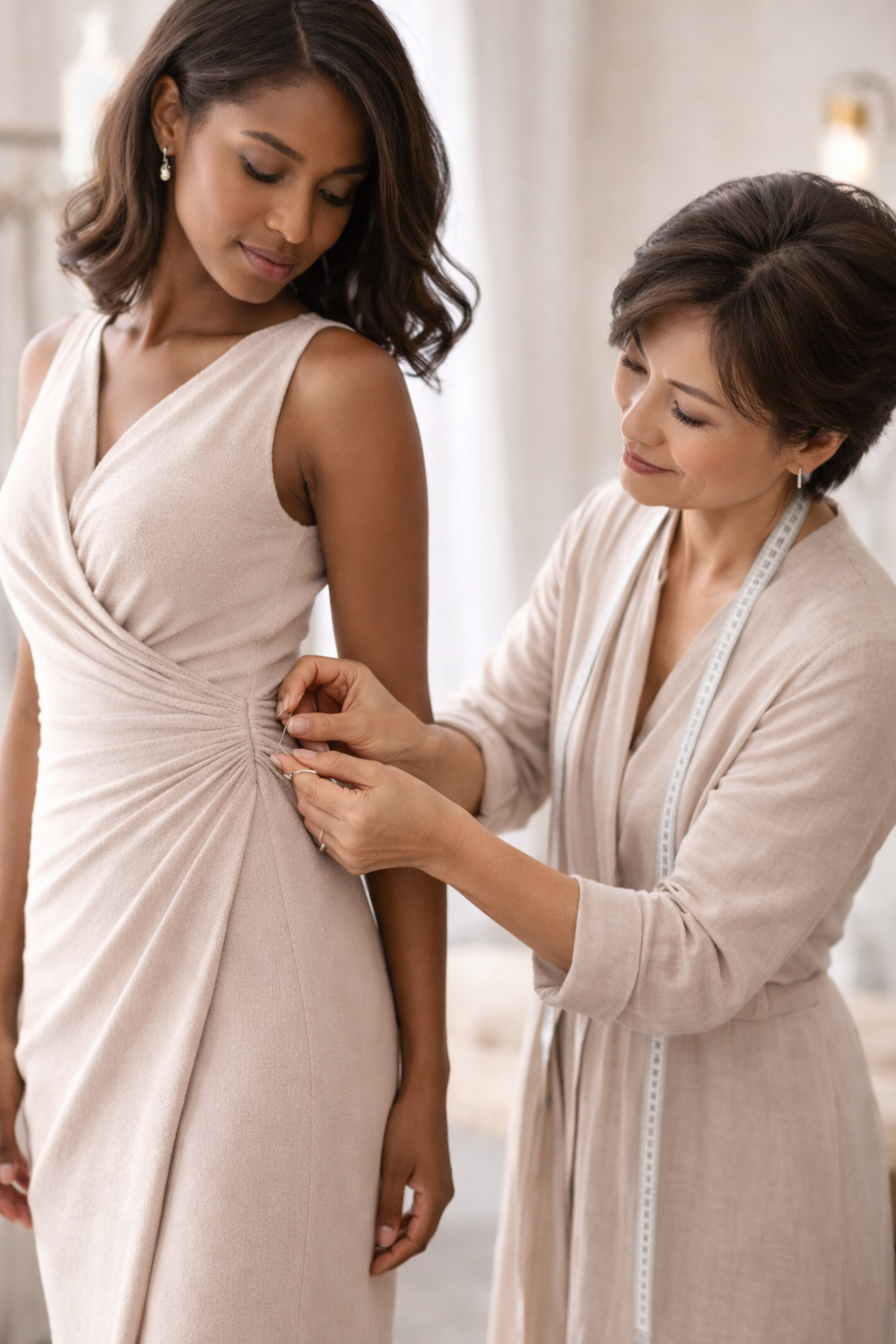
There is a particular grace in a woman who understands the quiet power of refinement. A garment that has been altered carries a different presence upon a woman’s frame. It does not overwhelm her; it accompanies her. The shoulder rests as it should. The waist follows her natural line. The hem concludes at a length that feels considered rather than incidental.
These details are subtle, yet they shift the entire silhouette from merely worn to fully inhabited. For generations, women have understood clothing not only as adornment, but as articulation. A seam adjusted is not vanity; it is clarity. The difference between fabric that drapes and fabric that resists. Between presence that is tentative and presence that is settled.
In fitting rooms and tailor shops, there is often a moment of quiet observation. A woman studies herself, not critically, but attentively. The mirror reflects posture, proportion, and movement. A sleeve slightly too long can soften authority. A misplaced waistline can blur intention.
To refine a garment is also to acknowledge one’s own evolution. Bodies change. Seasons of life leave their imprint. A dress may require easing at the seams; a structured jacket may need reshaping to reflect a different posture, a different confidence. These adjustments are not admissions of loss. They are affirmations of continuity.
Craftsmanship honors this continuity. The needle moves with patience. The iron presses with care. Balance and proportion are considered with an almost architectural eye. Beauty, in this sense, is rarely accidental. It is composed.
A woman who chooses alteration chooses participation. She enters into dialogue with her clothing.
Garments are no longer disposable; they become companions, reshaped and restored alongside her. There is something deeply feminine in this devotion to care. It reflects a broader sensibility: tending to what matters, preserving what is worthy, refining what already holds promise.
When a garment fits well, a woman does not appear constrained. She appears at ease. The fabric moves with her. The silhouette supports rather than competes. There is no distraction, only composure, and composure, once embodied, becomes visible.
Small acts…A hem lifted…A seam refined….A shape restored to balance.