
Measured Lines: Tailoring and the Discipline of Fit
There is a certain steadiness in a well-tailored garment. It does not seek attention. It establishes order. For a man, alteration is less about decoration and more about discipline. The line of a jacket must follow the shoulder cleanly. Trousers must fall with intention. A sleeve that ends precisely at the wrist reflects care, not excess. To refine a garment is to acknowledge that details matter, even those rarely noticed by others.
When a garment is left unaltered, it often carries excess, fabric where restraint is needed, length where precision would serve better. Alteration removes distraction. It clarifies proportion. It restores purpose. A properly tailored suit creates a silhouette that is neither rigid nor relaxed beyond measure. The chest is shaped, not exaggerated. The waist is defined, not constrained. The hem meets the shoe with intention. Nothing pools. Nothing strains. Such discipline extends beyond appearance. It reflects a man’s relationship with order. The inner seam. The reinforced button. The hand-finished cuff. These elements speak to integrity beneath the surface.
There is a long tradition in men’s tailoring that honors continuity. Jackets passed from one generation to another often bear the evidence of careful alteration—let out, taken in, adjusted for a new wearer. The structure remains. The proportions evolve.
Craftsmanship makes this possible.
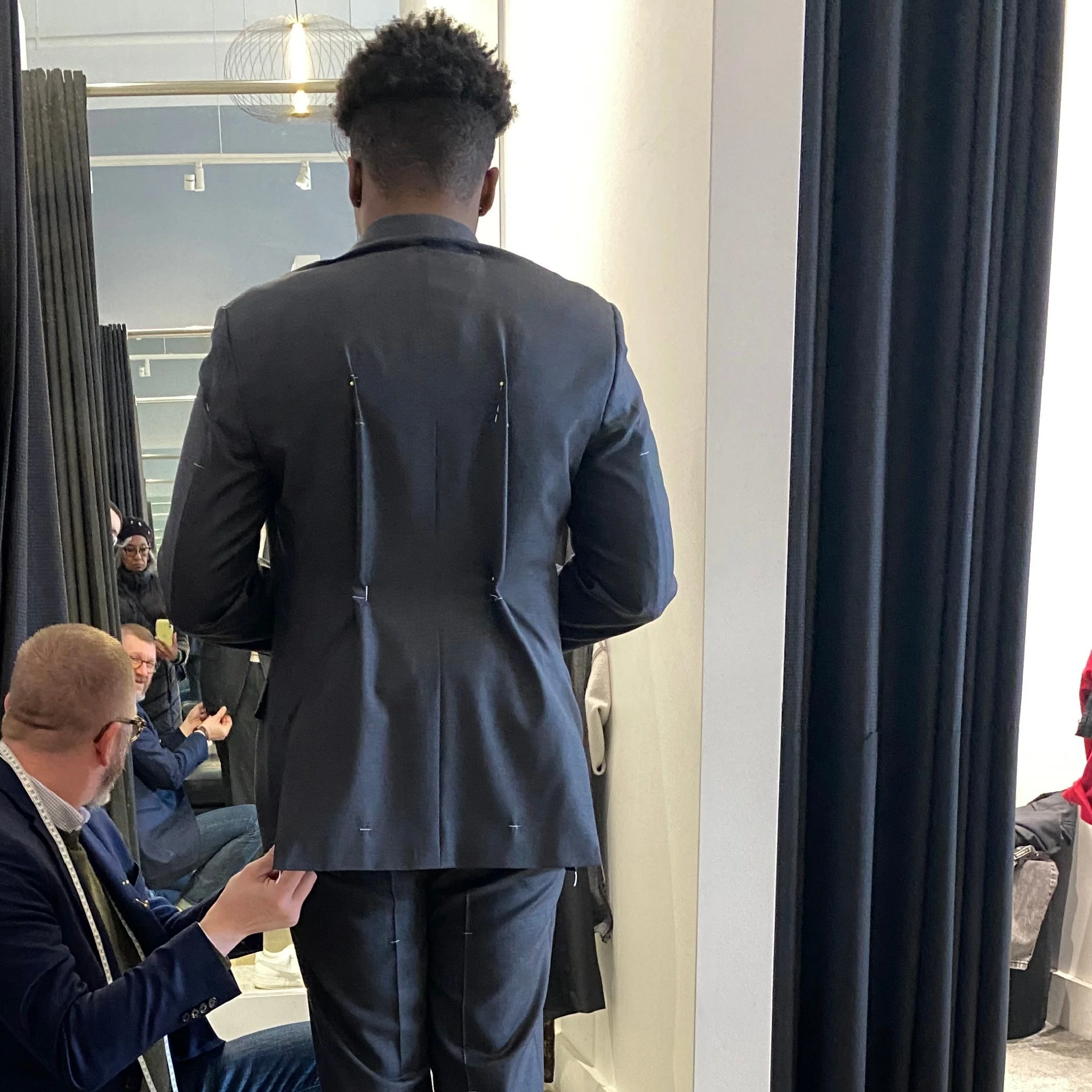
To stand for a fitting is a quiet exercise in awareness. Posture becomes evident. Proportion is assessed without exaggeration. The tailor marks adjustments with chalk, considering balance and movement.
At times, that moment looks like a young man standing still while a jacket is pinned along the back, preparing for an occasion that feels significant, perhaps even defining. There is nothing elaborate in the exchange. Only attention. Only care. The garment is shaped in real time, adjusted to meet him where he stands.
When the garment is returned, refined and pressed, something shifts. Not dramatically. Not performatively; but noticeably; the man moves with assurance. The fabric supports his stance. The line of the jacket reinforces his frame. The trousers break cleanly as he walks.
Alteration, at its finest, disappears. What remains is presence.
In a culture that favors speed, tailoring insists on patience. It favors longevity over immediacy. A well-altered coat endures. A properly fitted suit remains relevant because proportion—not novelty—defines it.
Measured lines. Balanced form. Quiet strength. These are the hallmarks of craftsmanship.